📖 Technical Information
Knowledge Base: KB-008
Category: Materials
Difficulty: Basics to Advanced
Reading time: approx. 15 minutes
Author: Tom DoManh – SFX Artist & Prosthetic Designer
Last updated: July 2026
Related Services: Film Prosthetics & Character Transformations · Mould Making & Special-Effects Fabrication
Related Projects: Knabe Mix · Old Age · Alien
Prerequisites: KB-001 to KB-007
Table of Contents
What Is Deadener?
Why Are Material Properties Adjusted?
What Role Does Mobility Play?
Typical Areas of Use
The Key Takeaways from Part 1
What Is Deadener?
In professional special-effects makeup, a variety of materials are used, each with its own specific properties.
Depending on the character, the area of use and the production's requirements, it can make sense to adjust these properties deliberately.
This is where the term deadener comes into play.
Deadener is not a prosthetic material in its own right but an additive that can be used to deliberately alter the properties of certain silicone systems. This allows materials to be adapted to different requirements without changing the fundamental fabrication process.
Which adjustments make sense always depends on the specific project and the desired character.
Why Adjust Material Properties at All?
No two characters are alike.
A large body prosthetic places different demands than a small facial prosthetic.
An old-age transformation also behaves differently than a fantasy creature or a bespoke anatomical piece.
That is why, in professional practice, it is often not enough to use a material unchanged.
Instead, as early as the planning phase, thought is given to which properties will best support the desired character.
Adjusting the material is therefore never an end in itself but part of a well-considered creative and technical workflow.
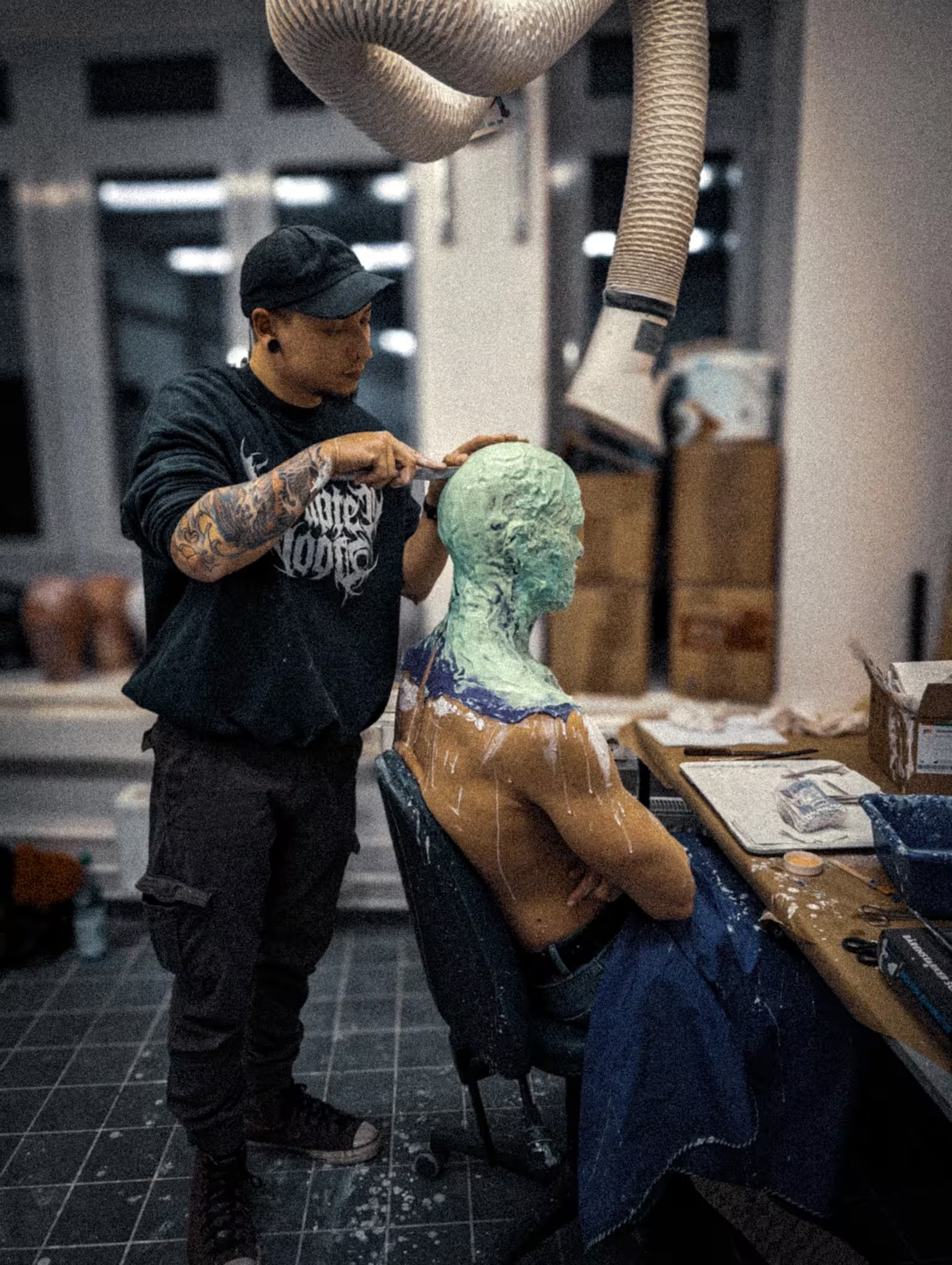
📦 Project Example – Knabe Mix
For the body prosthetic in the „Knabe Mix“ advertising campaign, the material had to follow the natural movements of the upper body while convincingly reproducing the sculpted skin textures. Requirements like these show that material properties must always be considered in the context of the overall character design.
➡️ Related Project: Custom Old Age Body Film Prosthetic „Knabe Mix“
The Material Always Follows the Character
A common misconception is that a material is chosen first and the character is then adapted to it.
In professional prosthetic design, the process runs exactly the other way around.
First come:
the character concept,
the sculpt,
the mould making,
the production planning.
Only then is it decided which material properties best support the execution.
This keeps the creative idea intact throughout the entire project.
📷 Recommended Image
📷 Old Age Prosthetics – Schauspiel Hannover
ALT Text
Multi-part old-age prosthetics with natural facial expression and harmonious movement.
Caption
Fig. 2: The choice of material follows the character's requirements – not the other way around.
💡 Practical Tip from DoManh SFX
For me, every project begins with the question of how a character should move and come across. Only once that foundation is in place do I decide which material properties can meaningfully support the desired effect. That way the choice of material always remains a tool – and never the starting point of the design.
Typical Areas of Use
Material adjustments play a role in, among others:
Old-age transformations
Body prosthetics
Custom facial prosthetics
Creature designs
Bespoke pieces
Advertising productions
Film productions
Theatre characters
Which adjustments make sense always depends on the requirements of the specific project.
Why Adjust a Material's Firmness at All?
Not every film prosthetic needs the same properties.
A small nose prosthetic places different demands than a large chest prosthetic, an old-age mask or a bespoke anatomical piece. That is why, in professional prosthetic design, thought is given as early as the project planning stage to how a prosthetic should later behave.
The point is not to make a material fundamentally "softer" or "firmer" but to tailor its properties to the intended purpose.
Deadener can help tune certain silicone systems so that they support the desired character as convincingly as possible.
Naturalness Comes from the Right Material Behaviour
A convincing film prosthetic does not live by its shape alone.
Just as important is the way it behaves in motion.
When speaking, smiling or turning the head, the skin is constantly moving. A prosthetic should follow these movements as harmoniously as possible and blend believably into the overall look.
The material properties make an important contribution to this.
They support the interplay of anatomy, facial expression and character design and help ensure that a prosthetic does not look like a foreign body.
📷 Recommended Image
Old Age Prosthetics – Schauspiel Hannover
t
Fig. 3: The material properties help a prosthetic move harmoniously with the performer's facial expressions.
💡 Practical Tip from DoManh SFX
The material properties should always suit the character. A prosthetic does not need to be as soft as possible – it needs to behave in a way that supports the illusion of the character. That is precisely why every material decision is made individually.
Every Production Has Different Requirements
In professional practice, there is no universal material setting.
Rather, the production's requirements determine which properties make sense.
These factors include, for example:
Type of character
Body region of the prosthetic
Range of movement
Camera distance
Wear time
Make-up requirements
Production schedule
These parameters determine which material properties are best suited to the specific project.
📦 Project Example – Knabe Mix
For the body prosthetic in the „Knabe Mix“ advertising campaign, it was crucial that the ageing details blended naturally into the movements of the upper body. That is why, already during planning, consideration was given to how the finished prosthetic should later behave on the performer.
➡️ Related Project: Custom Old Age Body Film Prosthetic „Knabe Mix“
Adjusting the Material Does Not Mean Improving Quality
A common misconception is that adjusting the material automatically results in a better film prosthetic.
In reality, it serves a different purpose.
The point is not to improve a material in general but to tailor its properties to a specific task.
Depending on the character, a different tuning may make sense.
That is why there is no universally "perfect" material setting.
The right decision always follows from the requirements of the project.
📷 Recommended Image
Alien SFX Make-up – ZDF Streamergarten
Fig. 4: Different characters place different demands on material and construction.
Material Knowledge Grows with Every Project
As experience grows, so does one's view of materials.
While beginners often look for general recommendations, experienced SFX artists learn to assess materials on a project-by-project basis.
It is not the brand or the product that matters most, but the question:
Which properties does this character really need?
This very mindset is one of the most important foundations of professional material selection.
📦 Did You Know?
Many high-quality film prosthetics look almost identical from the outside. The differences often lie in the material properties and in how well these were matched to the particular character and the production's requirements.
Material Adjustment as Part of the Professional Workflow
In professional special-effects makeup, the choice of material is never considered in isolation.
As early as the planning of a project, numerous factors feed into the decision. The goal is to develop a film prosthetic that not only looks convincing but can also be reliably fabricated, applied and used throughout the entire production.
Material adjustments are therefore not a single work step but part of a well-thought-out overall concept.
The Character Determines the Material Decision
Every character tells its own story.
An aged person, a fantasy creature or a bespoke anatomical piece place entirely different demands on form, movement and surface appearance.
For this reason, the material decision never begins with the question:
"Which material do I use?"
but with:
"Which properties does this character need?"
Only once this question is answered can it be decided which material properties will meaningfully support the desired effect.
📷 Recommended Image
Character Development & Sculpting – Vampire Sculpt
Fig. 5: The choice of material follows the character development – not the other way around.
💡 Practical Tip from DoManh SFX
For me, material decisions are not made at the mixing cup but already during character development. Once I know how a character should move, come across and work on camera, it becomes clear which material properties make sense.
Reliability in Everyday Production
Professional productions often work to a tight schedule.
Film prosthetics therefore not only have to be convincing in their design but also integrate reliably into the production workflow.
The following aspects, among others, play a role here:
consistent quality
reproducible results
reliable processing
predictable production workflows
consistent results across multiple prosthetics
Adjusting the material supports these requirements and helps ensure that the entire workflow runs efficiently and under control.
📦 Project Example – Old Age Prosthetics
For multi-part old-age transformations, several prosthetic pieces must later appear as if cast from a single mould. Careful material tuning helps all elements blend harmoniously into the overall look and maintain a consistent appearance throughout the production.
➡️ Related Project: Old Age Prosthetics Make-up – Schauspiel Hannover
Material Is Part of Quality Control
Quality does not begin with the finished prosthetic.
As early as the planning stage, all work steps are coordinated with one another.
These include:
Character development
Lifecasting or 3D scan
Sculpting
Mould making
Material selection
Painting
Application
Each of these areas influences the final result.
Material adjustment should therefore not be understood as an isolated measure but as part of professional quality management.
Further Reading:
KB-003 – What Is Lifecasting?
KB-004 – Character Development & Sculpting
KB-005 – Mould Making for Film Prosthetics
KB-007 – PlatSil Gel
📷 Recommended Image
Knabe Mix – Finished Body Prosthetic (Close-up)
Fig. 6: The final result emerges from the interplay of all work steps – from planning to the finished application.
Experience Creates Confidence
With growing experience, every prosthetic designer develops a better understanding of which material properties make sense for different projects.
These decisions are based not on fixed rules but on a combination of expertise, practical experience and the requirements of the particular production.
This is precisely why material knowledge is one of the most important skills of professional special-effects makeup artists.
It is not about knowing as many products as possible but about using their properties deliberately and effectively.
📦 Project Example – Alien SFX Make-up
The Alien SFX Make-up shows that material decisions are always closely tied to the desired character. Its stylised design placed different demands than a classic old-age transformation – and that is precisely why the entire workflow was planned accordingly.
➡️ Related Project: Alien SFX Make-up – ZDF Streamergarten
Why Adjusting Materials Is Standard Practice Today
The demands placed on modern film prosthetics are more varied than ever. High-resolution cameras, long shooting days and bespoke character designs call for solutions that go far beyond mere material selection.
That is why the deliberate adjustment of material properties is today part of the professional workflow of many special-effects productions.
However, the material itself is not the focus. What matters is that the finished prosthetic supports the character believably and meets the production's requirements.
Deadener is one example of how material properties can be adapted to different projects – always with the aim of supporting the character's intended effect.
📦 Project Example – Custom Old Age Body Prosthetic „Knabe Mix“
For the old-age transformation in the „Knabe Mix“ advertising campaign, material, character design and mobility had to work together harmoniously. As early as the planning phase, consideration was given to which properties the finished body prosthetic should have so that it would support the desired ageing effect naturally.
➡️ Related Project: Custom Old Age Body Film Prosthetic „Knabe Mix“
Material Is a Tool – Not a Solution
Beginners in particular often search for the "perfect material".
In professional practice, however, it quickly becomes clear that the material alone does not determine the quality of a film prosthetic.
A convincing character transformation only emerges when all areas of the workflow work together effectively:
Character development
Understanding of anatomy
Lifecasting or 3D scan
Sculpting
Mould making
Material selection
Painting
Application
Materials support this process – but they do not replace it.
💡 Practical Tip from DoManh SFX
I don't see deadener as an "improvement" to a material but as a way to tune material properties specifically to a project. The goal is never the softest or firmest possible material – but a film prosthetic that supports the character believably.
Experience Makes the Difference
With every project, one's understanding of how material, form and character interact grows.
Professional material decisions are therefore based not on technical data alone but on experience, observation and a direct connection to the particular project.
The better all the work steps are coordinated, the more natural the finished character transformation looks.
For this reason, material knowledge is one of the most important foundations of professional special-effects makeup.
📷 Recommended Image
Alien SFX Make-up – ZDF Streamergarten
Fig. 7: Material decisions are always guided by the requirements of the particular character and production.
Frequently Asked Questions (FAQ)
What Is Deadener?
Deadener is an additive that can be used with certain addition-cure silicone systems to adjust their mechanical properties in a targeted way. It is not a prosthetic material in its own right.
Why Is Deadener Used?
Deadener makes it possible to adapt material properties to the requirements of a specific project. This allows film prosthetics to be tuned specifically to their later use.
Does Deadener Make Every Film Prosthetic Better?
No. Deadener does not improve a material as a matter of principle. Its usefulness always depends on the requirements of the particular character and production.
Is Deadener Used on Every Film Prosthetic?
No. Whether adjusting the material makes sense is decided case by case. Many professional productions use different material concepts – depending on the character, the construction and the desired result.
Is Material Adjustment Part of Professional Prosthetic Design?
Yes. The deliberate tuning of material properties is an integral part of professional workflows and is planned together with character development, mould making and application.
Conclusion
Deadener exemplifies an important principle of professional special-effects makeup: materials are adapted to the character – not the other way around.
The deliberate adjustment of material properties makes it possible to tune film prosthetics even more precisely to a production's requirements. However, it is always only one part of a much larger process that ranges from the first idea to the finished character transformation.
Professional results come not from individual products but from the interplay of experience, planning and craftsmanship.
Further Content
Related Services
Film Prosthetics & Character Transformations
Character Development & Sculpting
Mould Making & Special-Effects Fabrication
On-Set SFX & Production Support
Related Projects
Custom Old Age Body Film Prosthetic „Knabe Mix“
Old Age Prosthetics – Schauspiel Hannover
Alien SFX Make-up – ZDF Streamergarten
Custom Dwarf Nose Prosthetic – HandOfBlood
More Articles from the Knowledge Base
KB-003 – What Is Lifecasting?
KB-004 – Character Development & Sculpting
KB-005 – Mould Making for Film Prosthetics
KB-006 – Encapsulated Silicone Prosthetics
KB-007 – PlatSil Gel
KB-009 – Cap Plastic – The Foundation of Fine Prosthetic Edges (coming soon)
Image Plan
Hero Image
📷 Knabe Mix – Finished Body Prosthetic
Shows a high-quality film prosthetic with natural mobility.
Figure 1
📷 Old Age Prosthetics – Schauspiel Hannover
Natural facial expression and harmonious material properties.
Figure 2
📷 Knabe Mix – Mould Making
The relationship between planning, mould making and material.
Figure 3
📷 Alien SFX Make-up – ZDF Streamergarten
Material adjustment for stylised character designs.
Figure 4
📷 Custom Dwarf Nose Prosthetic – HandOfBlood
Custom facial prosthetics with project-specific material requirements.
Sources and Further Technical Information
This article is based on practical experience in developing custom film prosthetics as well as on established practices in professional special-effects makeup.
For further technical depth, the following are recommended, among others:
Smooth-On – information on addition-cure silicone systems and their properties
KauPo – technical information on professional materials for prosthetic makeup
FormX – fundamentals of silicone systems and mould making
Stan Winston School – material use in prosthetic design
Neill's Materials – expertise and materials for SFX artists
Polytek – fundamentals of adjusting material properties in silicone systems