📖 Technical Information
InformationContent
Knowledge Base: KB-006
Category: Prosthetics
Difficulty level: Fundamentals to Advanced
Reading time: approx. 18 minutes
Author: Tom DoManh – SFX Artist & Prosthetic Designer
Last updated: July 2026
Related services: Film prosthetics & character transformations · Mould making & special effects fabrication
Related projects: Knabe Mix · Old Age · Alien · ColdScream
Prerequisites: KB-001 to KB-005
🟢 Cornerstone Article
This article explains the fundamentals of encapsulated silicone prosthetics and shows why this technique is so widely used today in film, advertising, theatre and high-end character transformations.
Table of Contents
What are Encapsulated Silicone Prosthetics?
Why are they used?
What advantages do they offer?
Typical applications
Key takeaways from Part 1
What are Encapsulated Silicone Prosthetics?
Encapsulated Silicone Prosthetics are custom-made film prosthetics in which a soft silicone core is enclosed by an extremely thin, dissolvable membrane.
This outer layer allows for exceptionally fine transitions between the prosthetic and the skin. As a result, transformations can be achieved that look natural even in close-up and can appear virtually invisible once made up.
Today, encapsulated silicone prosthetics are among the most frequently used techniques in professional prosthetic design and feature in numerous film, commercial and theatre productions.
Why has this technique become established?
As camera resolutions have increased, so have the demands placed on special effects make-up.
Whereas earlier prosthetics often showed clearly visible edges, modern fabrication techniques allow for far finer transitions and a more natural integration into a performer's face or body.
Encapsulated Silicone Prosthetics combine several qualities:
natural movement
realistic surface quality
fine transitions
comfortable wear
high level of detail
These qualities play a decisive role particularly in productions involving close-ups or long wearing times.
📦 Project example – Old Age Prosthetics
Multi-part ageing transformations frequently rely on encapsulated silicone prosthetics. Thanks to their fine transitions, the forehead, cheeks or neck can be combined harmoniously and then realistically integrated into the overall make-up.
➡️ Related project: Old Age Prosthetics Make-up – Schauspiel Hannover
Where are encapsulated silicone prosthetics used?
The applications are wide-ranging and extend far beyond classic feature films.
Typical areas of use include:
Film productions
Series
Commercials
Theatre
Streaming productions
Creature design
Fantasy characters
Ageing transformations
Body prosthetics
high-end cosplay projects
Depending on the project, individual areas of the face can be altered or entire body sections added.
📷 Recommended image
Old Age Prosthetics – Schauspiel Hannover
Fig. 2: Encapsulated silicone prosthetics allow for harmonious transitions between multiple prosthetic pieces.
💡 Practical tip from DoManh SFX
I use encapsulated silicone prosthetics especially when naturalness and movement are the priority. In close-ups in particular, it is often the fine transitions that make the decisive difference – they let the prosthetic work together with the performer's expressions rather than masking them.
What makes them so special?
The greatest advantage of encapsulated silicone prosthetics lies not in a single material, but in the interplay of construction, material properties and precise fabrication.
A professionally made prosthetic should support the character – not draw attention to itself.
That is why, alongside sculpting and mould making, material thickness, fit and careful workmanship also play a decisive role.
The goal is always the same: a character transformation that feels self-evident to the viewer.
Why do encapsulated silicone prosthetics look so realistic?
The success of a film prosthetic does not depend on its appearance alone. What matters is how it behaves during the performer's performance.
A high-quality prosthetic should support facial expression, blend harmoniously into the anatomy and remain as unobtrusive as possible even in close-up. This is exactly where encapsulated silicone prosthetics play to their greatest strengths.
Their construction creates natural transitions that visually integrate into the skin once made up. As a result, it is not the prosthetic that takes centre stage, but the character itself.
Naturalness emerges from the interplay of many factors
There is no single factor that makes a film prosthetic look realistic.
Rather, the result emerges from the interplay of various steps:
careful character development
anatomically accurate sculpting
precise mould making
an exact fit
high-quality painting
professional application
Only when these areas mesh together does a character transformation emerge that convinces even at close range.
📷 Recommended image
Old Age Prosthetics – Schauspiel Hannover
Fig. 3: A realistic character transformation emerges from the interplay of many carefully coordinated steps.
💡 Practical tip from DoManh SFX
A good film prosthetic should support the character – not distract from it. When viewers talk about the character rather than the make-up, the real goal has been achieved.
Movement makes the difference
The face and body are in constant motion.
When speaking, smiling or frowning, the skin moves continuously.
A film prosthetic must follow these movements as naturally as possible without impairing the performer's expression.
That is why it is not only the design of the prosthetic that matters, but also its integration into natural facial expression.
With modern film cameras in particular, this difference becomes especially visible.
📦 Project example – Old Age Prosthetics
For the multi-part ageing transformation at Schauspiel Hannover, it was important that the individual prosthetic pieces moved harmoniously with the performer's expressions. The aim was not a rigid mask, but a natural ageing effect that remained believable even during the performance.
➡️ Related project: Old Age Prosthetics Make-up – Schauspiel Hannover
A precise fit as the foundation
Even the highest-quality film prosthetic can lose its effect if it does not fit the performer's anatomy exactly.
That is why quality begins long before the actual fabrication.
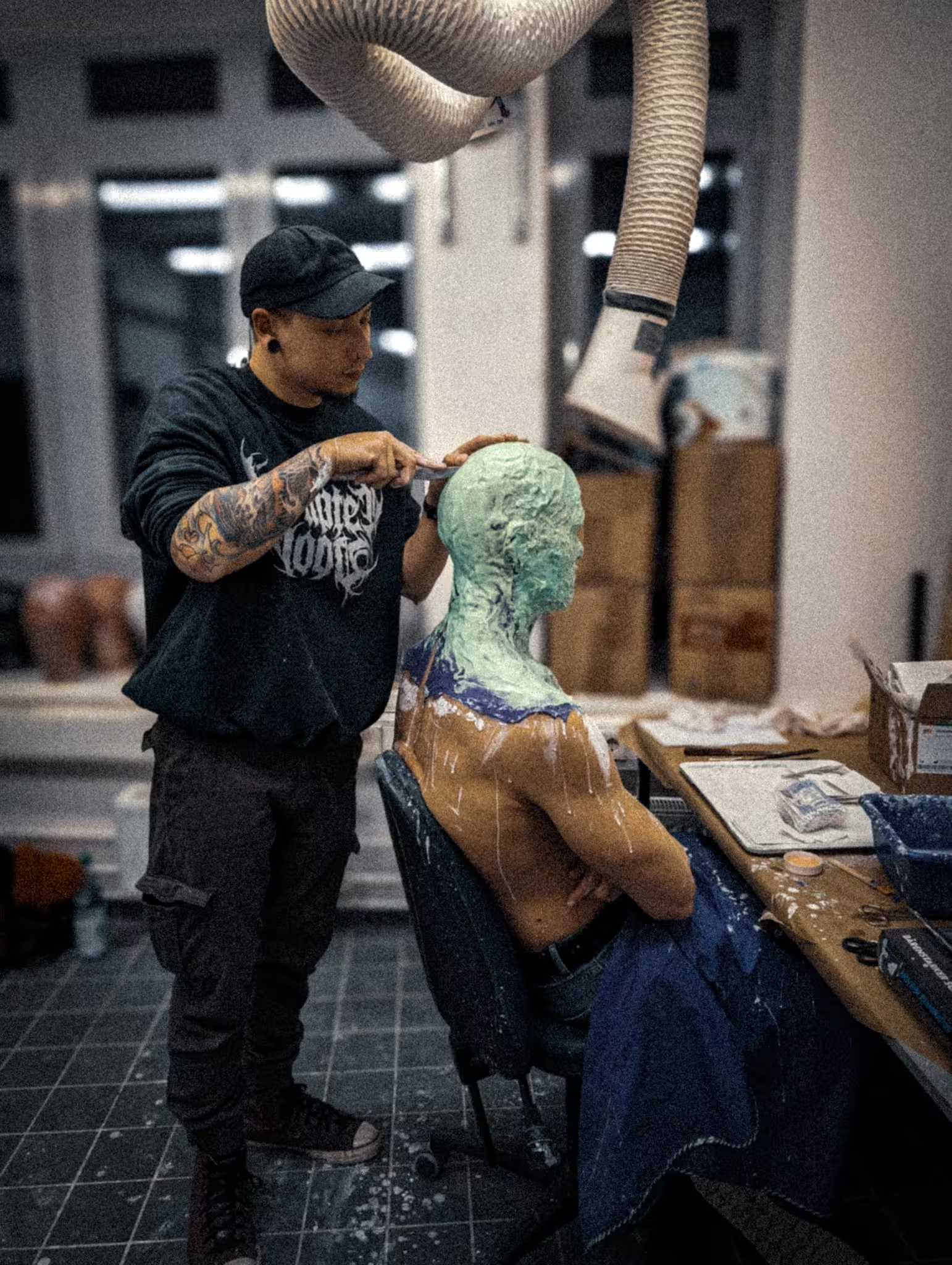
Lifecasting, digital 3D scans, character development and mould making together lay the foundation for a prosthetic that fits the body as precisely as possible.
The more accurate this preparatory work, the more harmonious the transitions and movements appear later.
📷 Recommended image
Knabe Mix – finished body prosthetic
Fig. 4: A precise fit forms the foundation for a believable character transformation.
Which characters are encapsulated silicone prosthetics suited to?
The technique is extremely versatile and can be used for the most varied characters.
These include, among others:
ageing transformations
fantasy characters
creatures and monsters
anatomical alterations
injury effects
custom facial prosthetics
body prosthetics
advertising characters
Which approach is chosen always depends on the creative requirements of the particular project.
📦 Project example – Alien SFX Make-up
For the Alien SFX Make-up, a character transformation with distinctly stylised forms was created. Despite the fantastical design, the prosthetics had to sit harmoniously and blend naturally into the overall look. This is exactly where it becomes clear that encapsulated silicone prosthetics are suited not only to realistic ageing but equally to creative creature designs.
➡️ Related project: Alien SFX Make-up – ZDF Streamergarten
Realism does not mean invisibility
A common misconception is that a film prosthetic has to be completely invisible.
In practice, the point is instead that it is perceived as a natural part of the character.
With a fantasy creature, the prosthetic may of course be visible – after all, it defines the look of the character.
What matters is that the forms, transitions and surfaces feel coherent and do not pull the viewer out of the story.
Realism therefore does not necessarily mean invisibility, but credibility within the particular character.
KB-006 – Part 3 of 4
Precision in every step
A high-quality encapsulated silicone prosthetic is not created by a single step or a particular material. It is the result of a carefully considered fabrication process in which each phase builds on the previous one.
Even small inaccuracies can carry through the entire workflow and affect the fit or the final appearance.
For this reason, every stage – from the first idea to the finished prosthetic – is planned and executed with great care.
Further reading: KB-002 – How are professional film prosthetics made?
Every step influences the final result
The quality of an encapsulated silicone prosthetic emerges from the interplay of various disciplines.
These include, among others:
character development
lifecasting or digital data capture
sculpting
mould making
fabrication of the prosthetic
painting
application on the performer
Each of these areas contributes to ensuring that the finished prosthetic not only looks convincing but also blends harmoniously into the character.
For this reason, individual steps can hardly be viewed in isolation – they form one coherent workflow.
📷 Recommended image
Knabe Mix – mould making
Fig. 5: Every encapsulated silicone prosthetic passes through several coordinated development and fabrication stages.
💡 Practical tip from DoManh SFX
For me, quality does not begin with the finished product. It begins in the very first project conversations. The better the planning, communication and preparation, the more smoothly the entire fabrication process runs later on.
Why experience plays a decisive role
Many steps in prosthetic design can be explained in theory.
Their practical execution, however, requires experience.
Every face has its own proportions.
Every body moves differently.
Every production brings new requirements.
That is why there is no universal solution that fits every project equally.
With every new character development, the understanding grows of how anatomy, mould making, material and later application can best be combined.
📦 Project example – Custom Dwarf Nose Prosthetic
For the custom-developed dwarf nose, the prosthetic not only had to fit the performer's anatomy but also allow enough freedom of movement for facial expression and acting. Projects like this show that even small prosthetics place high demands on planning, sculpting and fabrication.
➡️ Related project: Custom Dwarf Nose Prosthetic – HandOfBlood
Quality often shows in the small details
With high-quality film prosthetics, it is often the inconspicuous details that make the biggest difference.
These include, for example:
harmonious transitions
coherent proportions
natural skin textures
a clean fit
even surfaces
a believable interplay with light and make-up
Viewers rarely notice these features consciously. Yet they contribute significantly to making a character transformation convincing.
📷 Recommended image
Knabe Mix – close-up of the finished body prosthetic
Fig. 6: Fine surface details support the credibility of a professional character transformation.
Encapsulated Silicone Prosthetics in the professional workflow
Encapsulated silicone prosthetics have become indispensable in many film and advertising productions today.
They enable both subtle alterations and complex character designs and can be flexibly adapted to the requirements of a production.
Nevertheless, they always remain part of a larger overall concept.
Only the interplay of character development, mould making, material, painting and professional application turns a prosthetic into a convincing character transformation.
📦 Project example – Alien SFX Make-up
The Alien SFX Make-up shows that encapsulated silicone prosthetics are not used exclusively for realistic ageing. Stylised characters too benefit from a precise fit, cleanly worked forms and harmonious integration into the overall make-up.
➡️ Related project: Alien SFX Make-up – ZDF Streamergarten
Deepen your knowledge
If you would like to learn more about individual steps of the fabrication process, we recommend the following articles from the DoManh SFX Knowledge Base:
KB-002 – How are professional film prosthetics made?
KB-003 – What is lifecasting?
KB-004 – Character development & sculpting
KB-005 – Mould making for film prosthetics
Together, these articles provide a comprehensive overview of the professional workflow behind custom film prosthetics.
Why Encapsulated Silicone Prosthetics are the standard today
The demands placed on modern character make-up have risen steadily in recent years. High-resolution cameras, detail-rich close-ups and increasingly complex productions call for solutions that not only look convincing but also move naturally and can be reliably reproduced.
It is for exactly this reason that encapsulated silicone prosthetics have become established in many areas of professional special effects make-up.
They combine precise character development, high-quality material properties and a carefully considered fabrication process into a technique used in feature films as well as in advertising, theatre and streaming productions.
Yet the technique alone is never the focus – it is always the character it supports.
📦 Project example – Knabe Mix
For the ageing transformation in the „Knabe Mix“ advertising campaign, a custom-developed body prosthetic was created to blend harmoniously into the performer's anatomy. The project is a prime example of how encapsulated silicone prosthetics can be used to realise extensive character changes naturally and believably.
➡️ Related project: Custom Old Age Body Film Prosthetic „Knabe Mix“
Where do the greatest advantages lie?
Professionally made encapsulated silicone prosthetics offer numerous qualities that make them particularly interesting for high-end productions.
These include, among others:
natural integration into character make-up
realistic surface quality
high level of detail
individual adaptation to the performer
versatile applications
convincing results even in close-up
reproducible quality in series production
Which advantages matter most in each case always depends on the particular project and the creative requirements.
💡 Practical tip from DoManh SFX
For me, the best prosthetic is not the most elaborate one, but the one that supports the character believably. When technique, design and acting work together harmoniously, a transformation emerges that immerses the viewer in the story.
More than just a film prosthetic
Encapsulated silicone prosthetics are often associated with film productions.
In reality, however, their range of use extends considerably further.
They are used, among other things, for:
advertising productions
theatre productions
streaming formats
music videos
theme parks
professional cosplay projects
custom builds for individual character designs
The technique is suited wherever realistic or stylised characters are to be realised with a high level of detail.
📷 Recommended image
Alien SFX Make-up – ZDF Streamergarten
Fig. 7: Encapsulated silicone prosthetics are suited both to realistic characters and to creative creature designs.
Frequently Asked Questions (FAQ)
What are Encapsulated Silicone Prosthetics?
Encapsulated Silicone Prosthetics are custom-made silicone prosthetics with a thin outer membrane. They allow for exceptionally fine transitions and are frequently used for professional character transformations.
What are encapsulated silicone prosthetics used for?
They are used, among other things, in film, advertising, theatre, streaming productions, creature design and high-end cosplay projects.
Are Encapsulated Silicone Prosthetics reusable?
That depends on the particular construction, the material and the intended use. Many custom-made film prosthetics are produced for a specific project and are designed for professional use.
Why are they considered particularly high-quality?
Their construction allows for very fine transitions, a high level of detail and natural integration into character make-up. Combined with precise fabrication, this produces convincing results for professional productions.
Are encapsulated silicone prosthetics only suitable for films?
No. They are used equally for advertising campaigns, theatre, music videos, theme parks and individual character projects.
Conclusion
Encapsulated Silicone Prosthetics are among the most important techniques in professional special effects make-up today.
They enable individual character transformations with a high level of detail and support natural integration into the overall make-up. Their success, however, is based not on the material used alone, but on the interplay of character development, lifecasting, sculpting, mould making, precise fabrication and expert application.
It is precisely this interplay that makes encapsulated silicone prosthetics a firm part of modern film, advertising and theatre productions.
Further content
Related services
Film prosthetics & character transformations
Character development & sculpting
Mould making & special effects fabrication
On-set SFX & production support
Related projects
Custom Old Age Body Film Prosthetic „Knabe Mix“
Old Age Prosthetics – Schauspiel Hannover
Alien SFX Make-up – ZDF Streamergarten
ColdScream Cosplay Promotion
More Knowledge Base articles
KB-001 – What are silicone prosthetics?
KB-002 – How are professional film prosthetics made?
KB-003 – What is lifecasting?
KB-004 – Character development & sculpting
KB-005 – Mould making for film prosthetics
KB-007 – PlatSil Gel – properties and applications (coming soon)
Image plan
Hero image
📷 Knabe Mix – finished body prosthetic
Shows the final result of a high-quality Encapsulated Silicone Prosthetic.
Figure 1
📷 Old Age Prosthetics – Schauspiel Hannover
Multi-part facial prosthetics and natural transitions.
Figure 2
📷 Knabe Mix – mould making
The link between mould making and the finished prosthetic.
Figure 3
📷 Alien SFX Make-up – ZDF Streamergarten
Use of encapsulated silicone prosthetics for a stylised character transformation.
Figure 4
📷 ColdScream Cosplay Promotion
An example of using custom character prosthetics outside classic film productions.
Sources and further technical information
This article is based on practical experience developing and fabricating custom Encapsulated Silicone Prosthetics for film, advertising and theatre productions, as well as on established working methods in professional special effects make-up.
Suitable resources for further study include:
Smooth-On – technical information on silicone and mould making systems
Polytek – fundamentals of silicone materials and reproduction techniques
KauPo – materials and products for prosthetic makeup
FormX – information on sculpting and mould making materials
Stan Winston School – Prosthetic Makeup & Character Design
Neill's Materials – materials and expertise for professional SFX applications