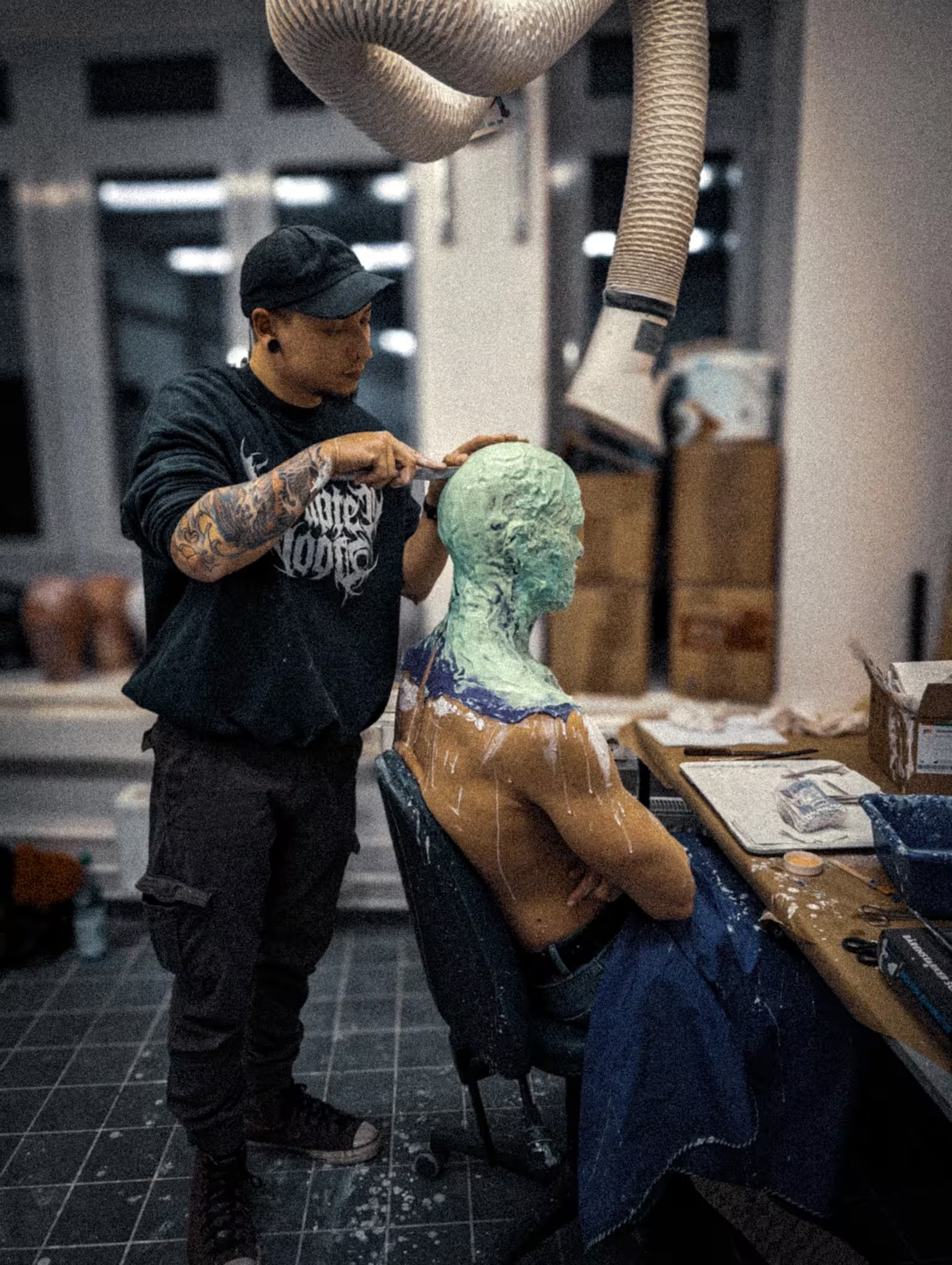
Why is a single prosthetic often not enough?
A film prosthetic is put under heavy strain during a shoot.
Depending on the production it has to be worn for many hours, survive different scenes and stay convincing throughout.
Despite careful work, damage or necessary adjustments can never be fully ruled out.
With additional prosthetics the production stays flexible and can keep working even when a prosthetic has to be replaced.
📷 Suggested image
Knabe Mix – several finished body prosthetics before application
Security for the production
Every shooting day costs money and ties up numerous departments.
When unplanned delays occur, they often affect not only the make-up department but the entire production team.
Multiple identical prosthetics help avoid downtime and give the production added planning security.
Especially with extensive character transformations, this preparation is an important part of a professional workflow.
📦 Case study – Knabe Mix
For larger productions, several copies of a prosthetic are often prepared. That way, the team can react quickly when needed without unnecessarily interrupting the planned schedule. It creates security for production, direction and performer.
➡️ Related project: Custom Old Age Body Film Prosthetic „Knabe Mix“
💡 Practical tip from DoManh SFX
Backup prosthetics don't mean that problems are expected. They are part of professional production planning and help keep things flexible even in unforeseen situations.
Why continuity matters so much in film
Films, series and commercials are rarely shot in the order in which they are later seen.
A scene from the beginning of a film may not be filmed until the final shooting day. In reality, two seemingly consecutive scenes can be days or even weeks apart.
So the viewer never notices, the character has to look the same in every shot.
In the film industry this is called continuity – the visual consistency of a character throughout the entire shoot.
Multiple shooting days – the same character
Especially with extensive character transformations, it is important that film prosthetics look as identical as possible on every shooting day.
Multiple prosthetics help reproduce this appearance reliably.
This ensures that:
shape and fit stay the same
skin texture looks identical
coloring appears consistent
the character is recognisable in every scene
For the viewer, this creates the impression that all scenes were filmed one right after another.
📷 Suggested image
Old Age Prosthetics – Schauspiel Hannover
ALT text
Professional ageing transformation with several coordinated prosthetic pieces.
💡 Practical tip from DoManh SFX
On longer productions I document key details of a character transformation so that prosthetics and make-up can be recreated as identically as possible on later shooting days. This preparation eases collaboration on set and supports consistent quality.
A backup isn't automatically an emergency
People often assume backup prosthetics are only made in case something gets damaged.
In practice, however, they serve several purposes.
They can be used, for example:
across multiple shooting days
in high-strain scenes
when different versions of a character are needed
as a reserve for unforeseen situations
This gives the production added flexibility and lets it respond better to changes in the shooting schedule.
📦 Case study – Old Age Prosthetics
With extensive character transformations involving several prosthetic pieces, careful preparation is especially important. When identical prosthetics are available, different shooting days can be planned efficiently and the desired look is maintained across the entire production.
➡️ Related project: Old Age Prosthetics Make-up – Schauspiel Hannover
Good preparation saves time on set
The better a production is prepared, the more smoothly the shooting day usually goes.
Multiple identical film prosthetics are therefore not only part of quality assurance but also support an efficient production process.
They give the team the ability to respond flexibly to changes without compromising the desired character transformation.
📷 Suggested image
Knabe Mix – body prosthetic before application
Exactly. 😄 I think this section is what makes the article credible. If we claimed that every production needs multiple prosthetics, that simply wouldn't be true. This way we show expertise and stay honest.
KB-016 – Part 3
Not every project needs multiple prosthetics
Even though backup prosthetics are used on many productions, they aren't required for every project.
Whether multiple identical prosthetics are made depends on various factors and is agreed with the production as early as the project planning stage.
Key factors include:
number of shooting days
scope of the character transformation
number of planned scenes
strain placed on the prosthetic
production process
budget and timeframe
For smaller projects or single-day productions, one prosthetic can be perfectly sufficient. More extensive productions, on the other hand, often benefit from additional copies.
Planning instead of improvisation
Professional film productions try to account for unforeseen situations in advance.
That includes deciding whether backup prosthetics make sense.
This planning creates security for everyone involved and helps direction, performers and the film crew focus on the actual shoot.
The number of prosthetics needed therefore always depends on the individual requirements of the project – not on a fixed rule.
📷 Suggested image
Character development & modelling – digital sculpt
ALT text
Digital planning of a custom film prosthetic as the basis for a professional production process.
💡 Practical tip from DoManh SFX
I discuss how many prosthetics make sense for a project as early as pre-production. That way the effort can be realistically assessed and the production gets exactly the solution it actually needs – no more and no less.
Quality also means working ahead
Professional special-effects make-up doesn't end with making a film prosthetic.
It also includes planning every step needed for smooth use during the production.
That includes, for example:
realistic scheduling
careful preparation
reliable documentation
close coordination with the production
forward-looking organisation
It is precisely this combination of craftsmanship and good planning that ensures film prosthetics not only look convincing but also integrate reliably into the day-to-day of production.
📦 Case study – Custom Dwarf Nose Prosthetic
When developing the custom dwarf prosthetic for HandOfBlood, a precise fit was the priority. Even during planning, we considered the demands the production placed on the prosthetic and how it could be reliably integrated into the shooting day.
➡️ Related project: Custom Dwarf Nose Prosthetic – HandOfBlood
Every production is unique
Commercial, feature film, streaming production or theatre – every project brings its own challenges.
That's why there is no universal number of film prosthetics required for every production.
A professional workflow always follows the requirements of the specific project and develops a solution that makes sense both creatively and organisationally.
📷 Suggested image
Custom Dwarf Nose Prosthetic – HandOfBlood
ALT text
Custom-made dwarf prosthetic for a professional commercial production.
Frequently asked questions (FAQ)
Why are multiple identical prosthetics made for film productions?
Multiple prosthetics increase planning security. They enable a smooth process on longer shoots, across multiple shooting days or during unforeseen events, and help keep the character consistent throughout the entire production.
Does every production need backup prosthetics?
No. Whether multiple prosthetics make sense depends on the requirements of the specific project. Factors such as shoot duration, character design and production process all play an important role.
Can backup prosthetics save time on set?
Yes. When additional prosthetics are available, they can be deployed quickly when needed. That reduces potential delays and eases the production process.
Do multiple prosthetics really look identical?
Professionally made film prosthetics are produced so that shape, fit and surface detail stay as consistent as possible. This creates a coherent appearance across all shooting days.
When is it decided how many prosthetics are needed?
This decision is usually made during pre-production. Together with the production, we determine the project's requirements and how many prosthetics make sense for a secure process.
Conclusion
Multiple identical film prosthetics are not a sign of waste but an expression of professional production planning.
They help respond flexibly to the realities of a shoot, ensure a character's visual continuity and reliably support the production process.
Whether one prosthetic or several are needed always depends on the requirements of the specific project. What matters is early planning, so that character design, fabrication and shooting can be optimally coordinated.
Related services
Film prosthetics & character transformations
On-set SFX & production support
Character development & modelling
Related projects
Custom Old Age Body Film Prosthetic „Knabe Mix“ – Instinct3
Old Age Prosthetics Make-up – Schauspiel Hannover
Custom Dwarf Nose Prosthetic – HandOfBlood
Alien SFX Make-up – ZDF Streamergarten
Sources
Stan Winston School – Prosthetic Design & On-Set Workflows
Neill's Materials – technical information on professional film prosthetics
Smooth-On – information on silicone systems for special effects
KauPo – materials for professional make-up artistry
Own project experience from film, commercial and theatre productions