📖 Technical Information
InformationContent
Knowledge Base: KB-004
Category: Prosthetics
Difficulty level: Fundamentals to Advanced
Reading time: approx. 18 minutes
Author: Tom DoManh – SFX Artist & Prosthetic Designer
Last updated: July 2026
Related services: Character Development & Sculpting · Film Prosthetics & Character Transformations
Related projects: Knabe Mix · Old Age · Gollum · ColdScream Cosplay
Prior knowledge: KB-001 to KB-003
🟢 Cornerstone Article
This article is one of the central fundamentals of the DoManh SFX Knowledge Base. It explains how, starting from an initial idea, character development and sculpting create the basis for a convincing film prosthetic.
Table of Contents
What does character development mean?
Why does good prosthetic design not start with silicone?
The idea behind every character
Research and references
The key takeaways from Part 1
(Further chapters follow in Parts 2–4.)
What does character development mean?
Every convincing film prosthetic tells a story. Long before materials are chosen or moulds are built, it must be clear who the character is and what effect they should have on the audience.
This is exactly where character development begins.
It combines creative design with an understanding of anatomy and forms the foundation for every subsequent step. The goal is not to create the most spectacular transformation possible, but to develop a character who feels believable and fits seamlessly into the story of a production.
Whether a subtle ageing effect, a striking fantasy creature or a complete body transformation – every decision made during the design stage shapes the final result.
Why does good prosthetic design not start with silicone?
Anyone encountering film prosthetics for the first time often thinks of silicone, moulds or special effects. In reality, however, the creative process begins long before that.
Before the first line is sculpted, some fundamental questions have to be answered:
Who is this character?
What story does their appearance tell?
What emotions should they convey?
How close does the camera get to the performer?
Should the transformation look realistic or stylized?
Which areas of the face or body change?
Only once these questions are answered does a concept emerge that serves as the basis for the later sculpting.
💡 Practical tip from DoManh SFX
For me, character development doesn't begin with tools or materials, but with a clear vision of the character. Every later decision – from the form to the skin texture – should support that idea. That is exactly how you create characters that not only stand out but also feel believable.
📷 Recommended image
gollum-makeup.jpg
Fig. 2: Convincing character development is always guided by the story and personality of the figure.
The idea behind every character
Every commission comes with its own requirements.
An advertising campaign pursues different goals than a feature film, and a stage play makes different demands than a cosplay project. That is why every character development begins with a thorough engagement with the project.
Among the aspects that play a role here are:
Genre and style of the production
Age and background of the character
Facial expression and mobility
Camera framing
Lighting concept
Costume and hair
Production time and budget
Together, these factors determine how far a transformation can go and which design choices make sense.
📦 Project example – Knabe Mix
For the advertising campaign “Knabe Mix”, the task was not to create a fantasy figure but to age the character believably. The ageing had to look natural even in close-ups while still allowing enough freedom of movement. These requirements were taken into account during the concept phase and influenced every subsequent step.
➡️ Related project: Custom Old Age Body Film Prosthetic “Knabe Mix”
Research and references
Once the concept is defined, the research begins.
Reference images, anatomical studies, historical sources or observations of nature help to better understand forms and proportions. The point is not to copy existing designs. Instead, references serve to support your own design work and to make well-founded decisions.
With ageing effects or creature designs in particular, a close look at real anatomy pays off. Many of the most convincing characters feel believable precisely because they are guided by natural forms.
Good research provides confidence for the rest of the project and makes communication with clients, direction and production easier.
📷 Recommended image
vampire-prosthetics-sculpt.jpg
Fig. 3: Before the actual sculpting, the design language, anatomy and character traits are defined.
Understanding anatomy – the foundation of every character development
A convincing film prosthetic is not created by adding as many details or spectacular forms as possible. Far more important is an understanding of how the human body is structured and how its anatomy changes over the course of a lifetime.
Muscles, fatty tissue, bone structures and skin together shape the appearance of a face or body. Anyone who understands these relationships can develop targeted changes that later look natural.
For this reason, the study of anatomy is one of the most important fundamentals for a prosthetic designer.
Reading forms instead of copying them
Many beginners initially focus on individual details such as wrinkles or skin textures. Experienced sculptors, by contrast, first look at the large forms.
Before fine details are created, they analyze:
How does the skull structure run?
Where are the largest volumes?
Which areas protrude?
Where do natural shadows form?
Which forms define the facial expression?
Only once these fundamental proportions are right is it worth working out the fine surfaces.
Convincing character development therefore develops from the large forms down to the smallest details – not the other way around.
📷 Recommended image
vampire-prosthetics-sculpt.jpg
Fig. 4: Before skin textures are sculpted, the proportions and volumes of the character must be coherent.
💡 Practical tip from DoManh SFX
When sculpting, I first ask myself whether the large forms work. Skin pores or fine wrinkles achieve little if the proportions, volume or facial expression aren't convincing. The strongest effect almost always comes from a clean base form.
Expression comes from proportions
Even small changes can noticeably alter the impression of a figure.
A slightly more pronounced chin, more prominent cheekbones or an altered brow area all influence how a character is perceived.
The point is not to exaggerate features. Often a few millimeters are enough to make a character look older, stronger, more exhausted or more threatening.
It is precisely these subtle adjustments that often make professional character developments more believable than exaggerated designs.
📦 Project example – Old Age Prosthetics
In an ageing transformation, the changes are not created by additional wrinkles alone. Among the decisive factors are sagging soft tissue, altered facial proportions and the natural loss of skin tension. These factors are considered during character development and form the basis for the later sculpting.
➡️ Related project: Old Age Prosthetics Make-up – Schauspiel Hannover
Realism or stylization?
Not every production pursues the same goal.
While historical films or commercials often call for the most realistic look possible, fantasy, horror or creature designs may be deliberately stylized.
Even so, many fantastical characters are still guided by real anatomical principles.
Even creatures feel more convincing when their forms are constructed in a comprehensible way and follow natural movement.
That is why anatomy and observation form the basis of every creative decision, even in stylized designs.
📷 Recommended image
gollum-makeup.jpg
Fig. 5: Even stylized characters feel more believable when they are based on anatomical fundamentals.
Observing instead of inventing
A large part of character development happens not at the sculpting table but through attentive observation.
Faces tell stories. Age, emotions, lifestyle and physical characteristics all leave visible traces.
Anyone who consciously notices these changes gradually develops a better sense for forms, proportions and characters.
For this reason, observation, sketches and anatomical studies are as much a part of the creative process as the actual sculpting for many professional prosthetic designers.
📦 Common misconception
“A good sculptor mainly needs talent.”
Talent can make the start easier, but convincing character development comes above all from continuous learning, observation and practice. Anatomy, proportions and a feel for form can all be trained and developed deliberately.
Small changes – big impact
Successful character development does not have to be as eye-catching as possible.
On the contrary: in film and advertising productions in particular, it is often the changes that are barely noticed at first glance that are the most convincing.
A slightly altered brow line, subtly more pronounced cheekbones or an adjusted jaw area can lastingly change the impact of a character without the prosthetic itself taking centre stage.
The goal is not to let the viewer recognise the prosthetic, but to let the character feel believable.
Sculpting – when an idea becomes a character
Once the concept, anatomy and character design are set, the actual sculpting begins.
In sculpting, all the previously developed ideas are translated into a three-dimensional form. The aim is not to sculpt as many details as possible, but to create a character whose forms, proportions and expression work together harmoniously.
Every change serves a specific purpose. It should support the story of the figure and make their personality visible.
A convincing sculpt is therefore not created by chance, but through many deliberate design decisions.
Classical sculpting – craft meets creativity
Classical sculpting has been one of the most important disciplines of special-effects makeup for decades.
On the basis of a positive model, forms are built up, adjusted and refined step by step. During this process, volumes, transitions and surfaces emerge that define the later character.
The great advantage of this approach lies in the direct contact with the model. Forms can be viewed from different angles, changed and assessed immediately.
Even today, classical sculpting remains an indispensable foundation for many projects.
📷 Recommended image
vampire-prosthetics-sculpt.jpg
Fig. 6: In classical sculpting, the character emerges step by step through the modelling of form, volume and anatomy.
Digital sculpting – new possibilities for character development
Digital tools have considerably expanded the creative workflow in recent years.
Programs such as ZBrush make it possible to model characters digitally, try out different design variants and implement changes efficiently. On complex projects in particular, forms can be adjusted flexibly without having to start again from scratch.
Digital modelling also opens up new possibilities for 3D printing and digital mould making.
Despite these advantages, the goal remains unchanged: convincing character development comes not from software, but from design understanding and anatomical knowledge.
📦 Practical example from the DoManh SFX workflow
For many of my current projects I now begin character development digitally in ZBrush. This makes it easy to compare different ideas quickly, check proportions and prepare models efficiently for the rest of the workflow. After that – depending on the project – comes the transition into mould making and the fabrication of the prosthetic.
Combining analog and digital workflows sensibly
In professional practice, classical and digital approaches are not mutually exclusive.
Many projects benefit from a combination of both methods.
One possible workflow might look like this:
digital capture of the anatomy
character development in ZBrush
3D printing of the model
mould making
fabrication of the film prosthetic
painting and application
Equally, classical sculpts can be developed further digitally, or digital models can be refined by hand afterwards.
Which approach is chosen always depends on the requirements of the project as well as the designer's personal preferences.
💡 Practical tip from DoManh SFX
For me there is no "analog versus digital". Both methods have their strengths. What matters is which tool best supports the particular step. In the end it isn't the workflow that counts, but the result.
Skin textures and surface detail
Once form and proportions are defined, work on the surface begins.
Fine skin pores, wrinkles, scars or other textures give the character additional depth and contribute significantly to its later believability.
The following, however, applies: surface details are the final refinement – not the foundation of the sculpt.
Only once anatomy, volume and proportions are coherent do these details achieve their full effect.
📷 Recommended image
knabe-mix-body-silicone-prosthetic-close.jpg
Fig. 7: Fine skin textures complement a convincing base form and add extra realism.
From sculpt to mould making
With the finished sculpt, the creative modelling phase comes to an end.
In the next step, the model is prepared for mould making so that every detail can be transferred to the later film prosthetic as precisely as possible.
The quality of the sculpting therefore directly affects the quality of every subsequent step.
A carefully developed character not only makes mould making easier, but also helps ensure that painting and application later work harmoniously.
📦 Project example – ColdScream Cosplay
For the ColdScream Cosplay, the focus was not on photorealistic ageing but on a striking, stylized character design. Even during sculpting, care was taken to ensure that the proportions supported the desired look and that the individual prosthetic pieces later fit harmoniously into the overall image.
➡️ Related project: ColdScream Cosplay
Character development is teamwork
Even though character development is often associated with sculpting, a convincing character is rarely created alone.
Already in the early concept phase, prosthetic designers work closely with direction, production, costume design, hair & make-up and – depending on the project – VFX departments. Each of these disciplines helps to ensure that a coherent overall picture emerges in the end.
A convincing character doesn't just have to look good. It has to move believably, fit the story, work under the lighting conditions and blend harmoniously into costume, make-up and camera work.
This is precisely why successful character development begins long before the actual sculpting.
📦 Project example – Knabe Mix
For the advertising campaign “Knabe Mix”, the challenge was to develop an aged torso that looks natural even in motion. Already in the planning phase, the design, wearing comfort and the demands of the production had to be coordinated. The final result was therefore not merely the outcome of a sculpt, but of close collaboration between everyone involved.
➡️ Related project: Custom Old Age Body Film Prosthetic “Knabe Mix”
Common misconceptions about character development
Anyone engaging with prosthetic design for the first time often associates character development purely with creative freedom. In reality, however, the design is influenced by many practical factors.
These include, among others:
the performer's anatomy
shooting conditions
camera framing
wearing comfort
mobility
production time
budget
the later application
A good design takes all of these aspects into account at an early stage of the project. This helps to avoid many challenges before the actual fabrication begins.
💡 Practical tip from DoManh SFX
For me, a sculpt is only successful when it not only looks good but can also be realized sensibly. Character design doesn't end at the modelling stage – it has to support the entire fabrication process.
Creativity needs structure
Many people imagine creative work as a spontaneous process.
In practice, however, a convincing character is rarely created by chance. Behind every film prosthetic lie research, an understanding of anatomy, numerous design phases and many small decisions.
The more structured this process is, the more efficiently changes can be made and the more clearly the character develops.
Creativity and planning are therefore not mutually exclusive – they complement each other.
📷 Recommended image
vampire-prosthetics-sculpt.jpg
Fig. 8: A convincing character emerges through the combination of creativity, an understanding of anatomy and structured work.
Frequently Asked Questions (FAQ)
What is meant by character design in prosthetic design?
Character design describes the creative development of a figure. The aim is to shape the appearance, anatomy and personality of a character so that they credibly fit the story and the production.
Is sculpting the same as character development?
No. Character development already begins with the idea and the concept. Sculpting is one of the later creative steps, in which these ideas are realized three-dimensionally.
Does every prosthetic designer have to work digitally today?
No. Both classical and digital sculpting have their firm place in professional makeup. Many artists combine both approaches.
What role does anatomy play in sculpting?
An understanding of anatomy helps to build up forms, volumes and proportions realistically. This makes both realistic and stylized characters more convincing.
Why does character development often take longer than expected?
A large part of the work consists of planning, research and reworking designs. Many decisions are made before the actual modelling even begins.
Conclusion
Character development and sculpting are among the most creative and, at the same time, most demanding areas of professional special-effects makeup.
They form the link between an initial idea and a finished film prosthetic. The point is not to create the most spectacular forms possible, but to develop characters who feel believable and support the story of a production.
An understanding of anatomy, careful planning and design experience form the foundation of every successful sculpt.
Whether done classically by hand or digitally with modern tools – in the end it is not the technique that decides, but the quality of the idea and its precise execution.
Further Content
Related services
Character Development & Sculpting
Film Prosthetics & Character Transformations
Mould Making & Special-Effects Fabrication
On-Set SFX & Production Support
Related projects
Custom Old Age Body Film Prosthetic “Knabe Mix”
Old Age Prosthetics – Schauspiel Hannover
ColdScream Cosplay
Alien SFX Make-up
Gollum Character Make-up
More articles from the Knowledge Base
KB-001 – What are silicone prosthetics?
KB-002 – How are professional film prosthetics made?
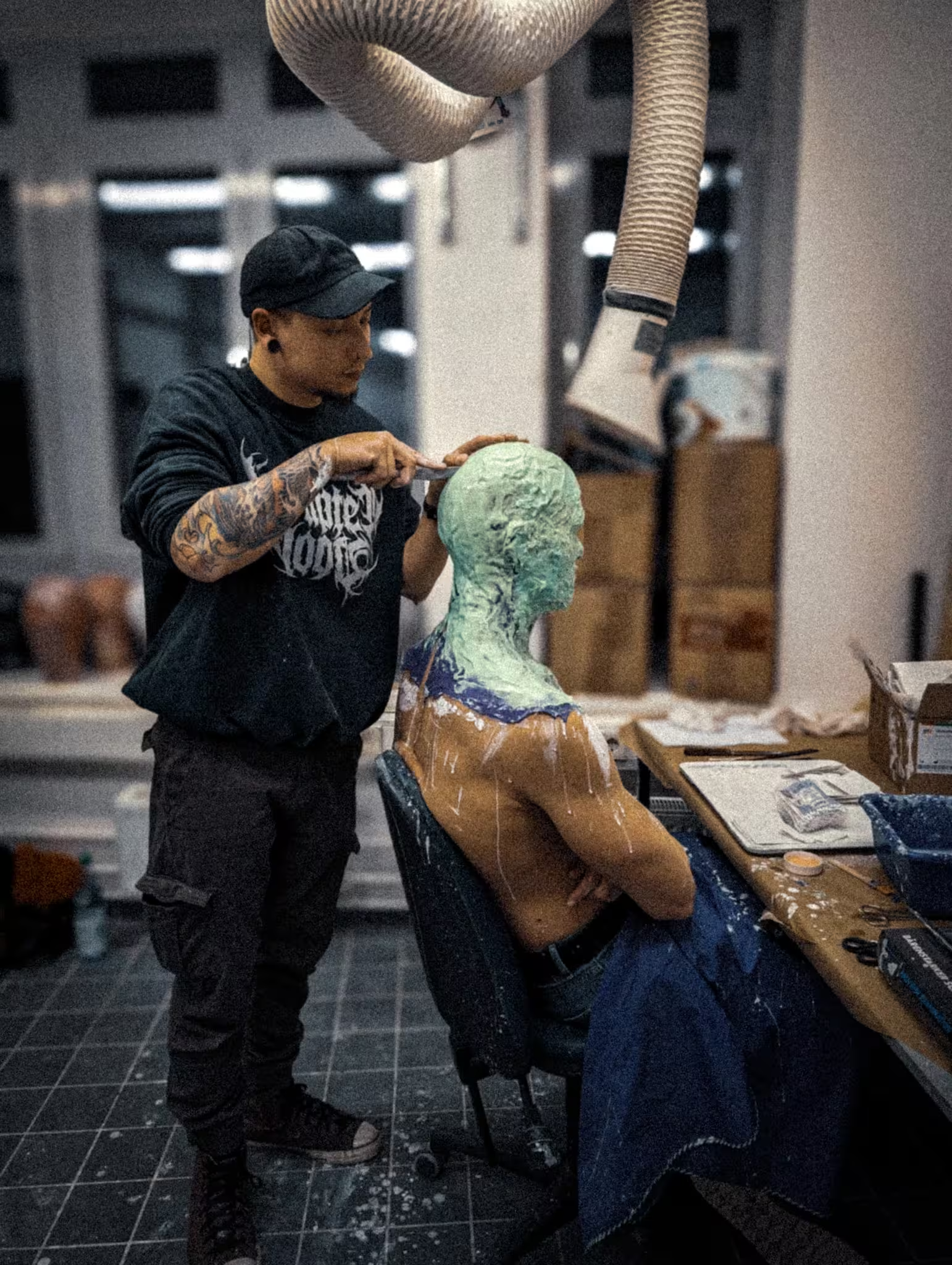
KB-003 – What is lifecasting?
KB-005 – Mould making for film prosthetics (coming soon)
KB-006 – Encapsulated Silicone Prosthetics (coming soon)
Image Plan
Hero image
Image:vampire-prosthetics-sculpt.jpg
ALT text:
Hand-sculpted sculpt as the starting point of a professional character development.
Figure 1
Image:gollum-makeup.jpg
Figure 2
Image:vampire-prosthetics-sculpt.jpg
Figure 3
Image:knabe-mix-body-silicone-prosthetic-close.jpg
Figure 4
Image:knabe-mix-body-prosthetic-finished-sfxmakeup.jpg
Sources and Further Technical Information
This article is based on practical experience developing custom film prosthetics for film, advertising, theatre and cosplay productions, as well as on generally accepted working practices of professional special-effects makeup.
For further technical study, the following are among the recommended resources:
Stan Winston School – Character Design & Prosthetic Sculpting
Gorton Studio – Character Development & Prosthetic Makeup
Smooth-On – Mould making and reproduction techniques
KauPo – Materials for professional film prosthetics
FormX – Technical information on modelling and mould-making materials