📖 Technical Information
InformationContent
Knowledge Base: KB-005
Category: Prosthetics
Difficulty level: Fundamentals to Advanced
Reading time: approx. 18 minutes
Author: Tom DoManh – SFX Artist & Prosthetic Designer
Last updated: July 2026
Related services: Mould Making & Special Effects Fabrication · Character Development & Sculpting
Related projects: Knabe Mix · Midwifery Examination Props · Dummy Head
Prerequisites: KB-001 to KB-004
🟢 Cornerstone Article
This article explains the importance of professional mould making within the prosthetic workflow and shows why high-quality moulds are decisive for fit, detail accuracy and reproducible results.
Table of Contents
What is mould making?
Why is mould making so important?
What functions does a mould serve?
Precision as the foundation of high-quality prosthetics
Key takeaways from Part 1
(Further chapters follow in Parts 2–4.)
What is mould making?
Once character development is complete and the sculpt has been fully modelled, the next crucial step follows: mould making.
Here the finished model is transferred into a mould that later serves as the basis for producing the actual film prosthetic.
This mould captures every contour, surface texture and transition as accurately as possible. It ensures that the painstakingly modelled details can be reliably reproduced – whether a single prosthetic or several identical pieces are required.
Mould making thus connects the creative sculpting phase with the actual fabrication of the prosthetic.
Why is mould making so important?
A film prosthetic is only ever as good as the mould it comes from.
Even a superbly modelled character can lose its quality if surfaces are not transferred cleanly or the mould works imprecisely.
Professional mould making therefore pursues several goals at once:
precise transfer of all details
reproducible results
clean material thicknesses
reliable fit
efficient production of multiple prosthetics
The higher the quality of the mould, the more consistently the quality of the later prosthetics can be ensured.
📦 Project example – Dummy Head for Game Two
For the silicone dummy head made for Game Two / Rocket Beans, the mould had to transfer not only fine skin detail but also accommodate larger components with precision. With special props like these in particular, the mould making determines whether all the individual parts fit together cleanly later on and whether the desired detail accuracy is retained.
➡️ Related project: Realistic Silicone Dummy Head
What functions does a mould serve?
Mould making does far more than simply "casting" a model.
A professionally developed mould ensures, among other things, that:
the sculpt is reproduced faithfully,
material can be processed in a controlled way,
prosthetics are produced reproducibly,
delicate areas remain protected,
demoulding is as gentle as possible.
Depending on the project, the build and construction of the mould differ considerably. That is why every mould is tailored individually to the requirements of the respective project.
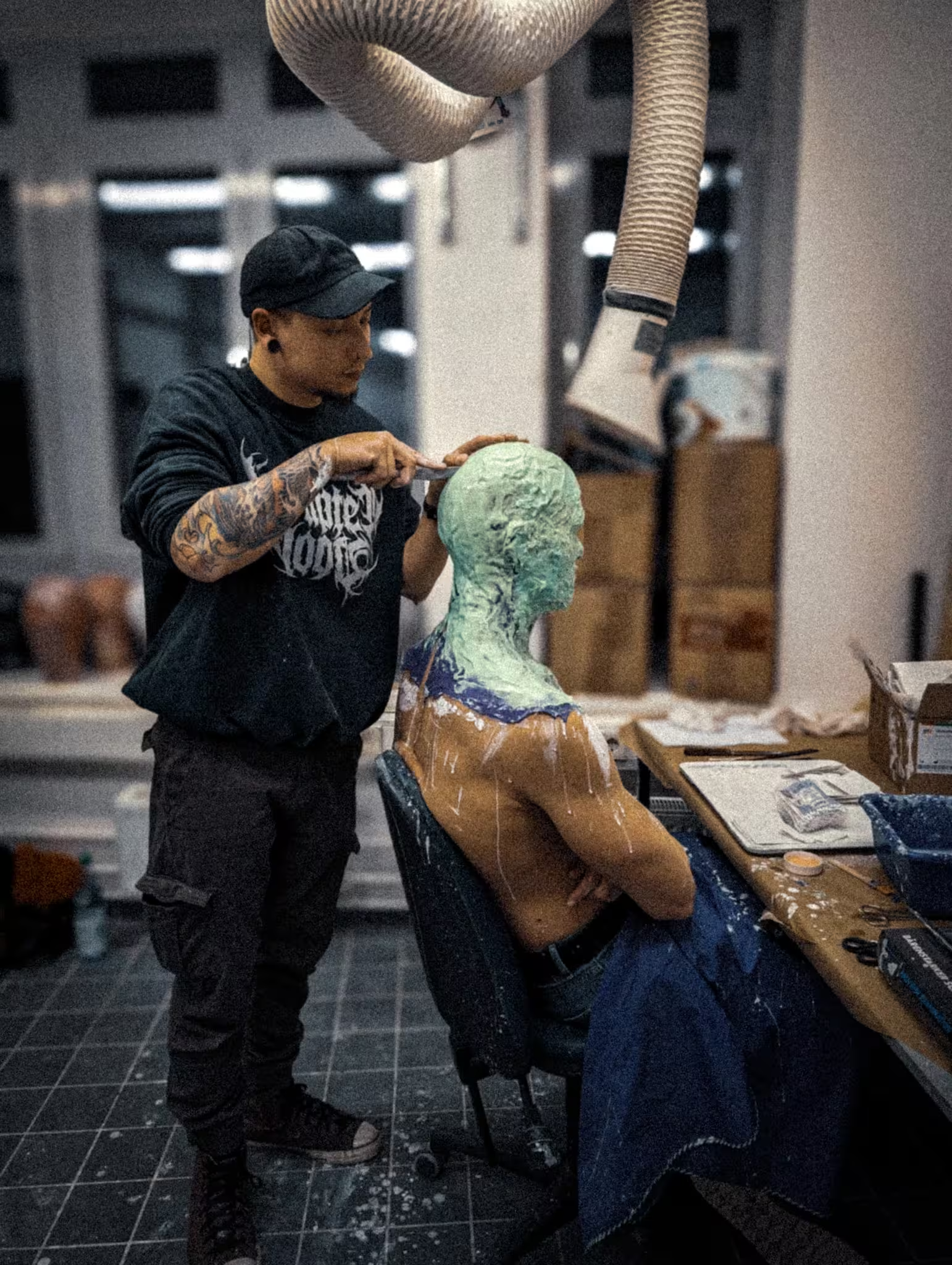
📷 Recommended image
➡️ Body Mould – Knabe Mix
ALT text
Multi-part mould of a body prosthetic during fabrication.
Caption
Fig. 2: Professional moulds are tailored individually to each project and enable precise reproduction of the sculpt.
💡 Practical tip from DoManh SFX
A good mould later goes almost unnoticed – its quality shows in every single prosthetic that comes out of it. That is why I invest a great deal of time in planning and construction before any material is ever processed.
Precision begins in the planning
Successful mould making does not start with the actual building of the mould.
Important decisions are already made during the planning stage:
Where do the parting lines run?
Which areas need particular stability?
How can fine details be preserved optimally?
How is later demoulding accounted for?
How can consistent quality be ensured across multiple casts?
These considerations influence the entire subsequent fabrication process and contribute significantly to the quality of the finished film prosthetic.
Every mould is an individual solution
In professional mould making there is no universal solution. Every film prosthetic places its own demands on construction, stability and handling. That is why every mould is planned individually and adapted to the respective project.
While small facial prosthetics can often be produced with comparatively compact moulds, large-area body prosthetics or special props call for far more complex constructions.
It is at this stage that it is decided how efficiently the later fabrication will run and how reliably the quality can be reproduced.
Mould making begins long before the first material
Many people associate mould making with the actual casting of a mould. In reality, however, this process begins considerably earlier.
Even during planning, numerous decisions are made that shape the further course of the work:
How can the model be safely demoulded later?
Which areas need additional stability?
Where do sensible parting lines run?
Which surfaces need particular protection?
How can multiple identical prosthetics be produced efficiently?
Careful planning reduces later corrections and contributes significantly to the quality of the finished prosthetic.
📷 Recommended image
Knabe Mix – Mould Making Body Mould
ALT text
Multi-part mould of a body prosthetic being prepared for fabrication.
Caption
Fig. 3: Important decisions for the entire production process are made as early as the planning stage.
💡 Practical tip from DoManh SFX
In mould making I always think several steps ahead. A well-planned mould not only makes producing the first prosthetic easier, it also ensures that every further piece reaches the same quality.
Why many moulds are built in multiple parts
The more complex a character is designed to be, the more demanding the mould making becomes.
Strong undercuts, striking anatomy or large-area body prosthetics often cannot be realised with a simple mould.
That is why professional moulds frequently consist of several precisely matched segments.
This construction makes it possible to
preserve fine details reliably,
protect delicate areas,
ease later demoulding,
achieve reproducible results.
The number of mould parts is always governed by the requirements of the respective project – not by a fixed rule.
📦 Project example – Knabe Mix
For the large-area body prosthetic of Knabe Mix, the mould making had to be planned so that all skin structures and anatomical changes could be transferred precisely. At the same time, the construction needed to allow safe demoulding and permit several identical prosthetics of consistent quality.
➡️ Related project: Custom Old Age Body Film Prosthetic "Knabe Mix"
Mould making for special props
The basic principles of mould making are not limited to film prosthetics.
A precise mould also plays a decisive role in special props.
Depending on the project, the demands on stability, material thickness or later assembly differ considerably.
While flexibility and fine skin detail are often the priority for film prosthetics, moulds for special props frequently have to accommodate larger components or account for additional construction elements.
The underlying idea, however, remains the same: the mould should reproduce the original model as precisely as possible.
📷 Recommended image
Realistic Silicone Dummy Head – Game Two
ALT text
Mould making for a realistic silicone dummy head as a special prop.
Caption
Fig. 4: The basic principles of professional mould making apply to special props as well.
Precision saves time
At first glance, elaborate mould making seems to lengthen the production process.
In practice, the opposite is often the case.
A carefully developed mould eases many later steps and reduces the effort involved in:
producing multiple prosthetics,
quality control,
finishing work,
the fit,
the repeatability of complex projects.
That is why, in professional productions, mould making is not regarded as a necessary evil but as an important part of quality assurance.
📦 Did you know?
Larger film productions frequently require several identical prosthetics of one character. A precise mould ensures that these prosthetics look as alike as possible and can be processed consistently – an important factor for continuity during shooting.
Mould and Material – A Well-Rehearsed System
Professional mould making does not end with the finished mould. Only in interplay with the chosen material does it become clear how well a construction actually works.
Mould and material influence one another. A precise mould supports the processing of the material, while the properties of the material in turn place demands on the construction of the mould.
That is why both aspects are considered together as early as the project planning stage and not developed independently of one another.
Every production places different demands
Not every film prosthetic has to serve the same purpose.
A character for a commercial places different demands than a theatre production or a creature design for a feature film.
Depending on the field of use, the following factors, among others, come into play:
detail accuracy
flexibility
size of the prosthetic
wear time
camera distance
number of prosthetics required
production time
Mould making is therefore always adapted to the requirements of the respective project and, together with the choice of material, forms the foundation for a convincing result.
📦 Project example – Anatomical Sculpting for Midwifery Examination Props
For the anatomical training models for the midwifery examination, the focus was not on a character transformation but on reproducing anatomical structures as precisely as possible. The mould making therefore had to be carried out with particular attention to detail, so that the later models could reliably fulfil their function in everyday training.
➡️ Related project: Anatomical Sculpting for Midwifery Examination Props
Precision decides every detail
Mould making transfers more than just the large forms of a sculpt.
The smallest skin structures, fine transitions and subtle modelling are carried over too.
It is precisely these details that later contribute significantly to making a film prosthetic look natural.
The more precisely the mould is made, the more accurately these surfaces can be reproduced and the less rework is required later.
📷 Recommended image
Knabe Mix – Close-up of the finished prosthetic
ALT text
Close-up of a film prosthetic with realistic skin texture.
Caption
Fig. 5: Fine skin structures are created during the sculpting and are transferred faithfully through the mould making.
💡 Practical tip from DoManh SFX
Many people look first at the striking details. For me, though, it is often the small transitions that are decisive. When skin structures, edges and surfaces work together cleanly, a prosthetic looks far more natural – even if the viewer does not consciously perceive the difference.
Quality does not begin only with the finished product
The quality of a film prosthetic cannot be judged by the finished result alone.
It is created step by step throughout the entire fabrication process.
Important conditions are already established during mould making:
clean fit
even material distribution
reproducible results
stable production workflows
reliable detail accuracy
For this reason, in professional productions mould making is understood as part of quality assurance and not merely as preparation for the actual casting.
Experience is no substitute for planning – and planning none for experience
Professional mould making combines technical understanding with practical experience.
Even after many projects, every new mould begins with a careful analysis of the requirements.
What stresses arise during fabrication?
How can the model be safely demoulded?
Which areas need particular attention?
These questions cannot be answered in blanket terms; they always arise from the respective project.
That is precisely why mould making is one of the most demanding areas of special effects prosthetic make-up.
📦 Project example – Realistic Silicone Dummy Head
In developing the silicone dummy head for Game Two / Rocket Beans, the mould making had to accommodate different areas precisely while at the same time enabling reliable fabrication. The construction of the mould was just as important as the original sculpt, since together they formed the foundation for the finished prop.
➡️ Related project: Realistic Silicone Dummy Head
Mould making as an invisible quality factor
For the audience, mould making usually remains invisible.
All that is seen later is the finished film prosthetic.
It is precisely for this reason that its importance is often underestimated.
In practice, however, this step determines whether a character transformation can be realised reproducibly, whether fine details are preserved and whether the finished prosthetic meets the demands of a professional production.
High-quality mould making thus creates the foundation for all further steps – from fabrication to final application.
Mould making as the foundation of professional productions
For many viewers, mould making remains invisible. On screen or in the finished commercial, only the film prosthetic is seen – not the elaborate preparation behind it.
In practice, however, mould making is one of the decisive quality factors of professional character development. It connects creative sculpting with the actual fabrication and creates the conditions for reproducible results.
The more precisely the mould is developed, the more reliably details, fit and material properties can be maintained throughout the entire production process.
📦 Project example – Knabe Mix
For the body prosthetic of the "Knabe Mix" project, mould making played a central role. The large-area anatomy of the upper body had to be realised so that skin structures, transitions and proportions could be reproduced identically even across several prosthetics. Careful planning made a consistently high quality possible throughout the entire production.
➡️ Related project: Custom Old Age Body Film Prosthetic "Knabe Mix"
Mould making means more than just a mould
Professional mould making pursues far more than the goal of duplicating a sculpt.
It creates the foundation for:
prosthetics that can be produced reproducibly,
fine skin structures being preserved,
material being processed in a controlled way,
fit and detail accuracy remaining consistent,
later steps interlocking efficiently.
In this way, mould making forms a bridge between creativity and technical execution.
💡 Practical tip from DoManh SFX
For me, mould making is far more than a technical step. A well-planned mould creates certainty for the entire subsequent workflow. It means that during fabrication I can concentrate on the quality of the prosthetic rather than on avoidable problems.
Experience develops with every project
Every project brings new challenges.
Different anatomies, complex characters or unusual special props call for new solutions again and again.
That is why there is no universal standard mould in professional mould making.
Instead, experience grows with every completed project. Every new challenge deepens the understanding of how moulds are built, planned and adapted to different requirements.
It is precisely this continuous development that makes mould making one of the most exciting areas of special effects prosthetic make-up.
📷 Recommended image
Anatomical Sculpting for Midwifery Examination Props
ALT text
Precisely crafted anatomical models as an example of professional mould-making and sculpting craft.
Caption
Fig. 6: Different projects place different demands – which is why mould making is tailored individually to each undertaking.
Frequently Asked Questions (FAQ)
What is mould making?
Mould making describes the process in which a finished model or sculpt is transferred into a mould. This mould later serves as the basis for producing film prosthetics, special props or other SFX components.
Why is mould making so important?
A high-quality mould ensures that surface details, fit and material thicknesses can be reproduced as precisely as possible. It thus directly influences the quality of the finished prosthetic.
Are there different types of moulds?
Yes. Depending on the project, the build and construction differ considerably. Which mould is suitable depends on geometry, material and the requirements of the later fabrication.
Is mould making part of character development?
Mould making follows character development and sculpting. Both areas interlock closely and together form the foundation of professional film prosthetics.
Are moulds used only for film prosthetics?
No. Mould making is also used for special props, anatomical models, masks, creature designs and various bespoke pieces, among other things.
Conclusion
Mould making is one of the most important technical disciplines of professional special effects prosthetic make-up.
It connects creative character development with the actual fabrication and ensures that ideas can be reliably turned into high-quality film prosthetics and special props.
A carefully developed mould not only improves the quality of the end product, it also supports the entire production process – from the first prosthetic to the last shot on set.
Professional mould making usually remains invisible to the audience. Its influence on the quality of a character transformation, however, can hardly be overstated.
Further Content
Related services
Mould Making & Special Effects Fabrication
Character Development & Sculpting
Film Prosthetics & Character Transformations
On-Set SFX & Production Support
Related projects
Custom Old Age Body Film Prosthetic "Knabe Mix"
Realistic Silicone Dummy Head – Game Two
Anatomical Sculpting for Midwifery Examination Props
Custom Dwarf Nose Prosthetic – HandOfBlood
Further Knowledge Base articles
KB-001 – What are silicone prosthetics?
KB-002 – How are professional film prosthetics made?
KB-003 – What is lifecasting?
KB-004 – Character Development & Sculpting
KB-006 – Encapsulated Silicone Prosthetics (coming soon)
Image Plan
Hero image
📷 Knabe Mix – Body Mould
Figure 1
📷 Realistic Silicone Dummy Head
→ Project example special props
Figure 2
📷 Knabe Mix – Mould Making
→ Multi-part body mould
Figure 3
📷 Midwifery Examination Props
→ Precision and detail accuracy
Figure 4
📷 Custom Dwarf Nose Prosthetic
→ Small-scale moulds for individual facial prosthetics
(I actually find this more fitting here than showing the Knabe Mix again.)
Sources and Further Technical Information
This article is based on practical experience from developing bespoke film prosthetics, special props and anatomical models, as well as on established working methods of professional special effects prosthetic make-up.
For further technical depth, the following are suitable, among others:
Smooth-On – Information on mould-making materials and reproduction techniques
Polytek – Technical fundamentals of mould systems
KauPo – Materials for professional prosthetic workflows
FormX – Technical information on sculpting and mould-making materials
Stan Winston School – Mould making and prosthetic design
Gorton Studio – Professional prosthetic make-up and character fabrication