📖 Technical information
KnowledgeBase:KB-003
Category: Prosthetics
Difficulty: Fundamentals
Reading time: approx. 16 minutes
Author: Tom DoManh – SFX Artist & Prosthetic Designer
Last updated: June 2026
Related services: Character Development & Sculpting · Film Prosthetics & Character Transformations
Related projects: Knabe Mix · Old Age
Prerequisites: KB-001 and KB-002
🟢 Cornerstone article
This article is one of the fundamentals of the DoManh SFX Knowledge Base.
It explains the role of lifecasting in the professional process of making film prosthetics and forms the basis for advanced topics such as sculpting, mould making and character development.
Table of contents
What is lifecasting?
Why is a lifecast so important?
Which body areas can be moulded?
When is a lifecast used?
The key takeaways from Part 1
(Further chapters follow in Parts 2–4.)
What is lifecasting?
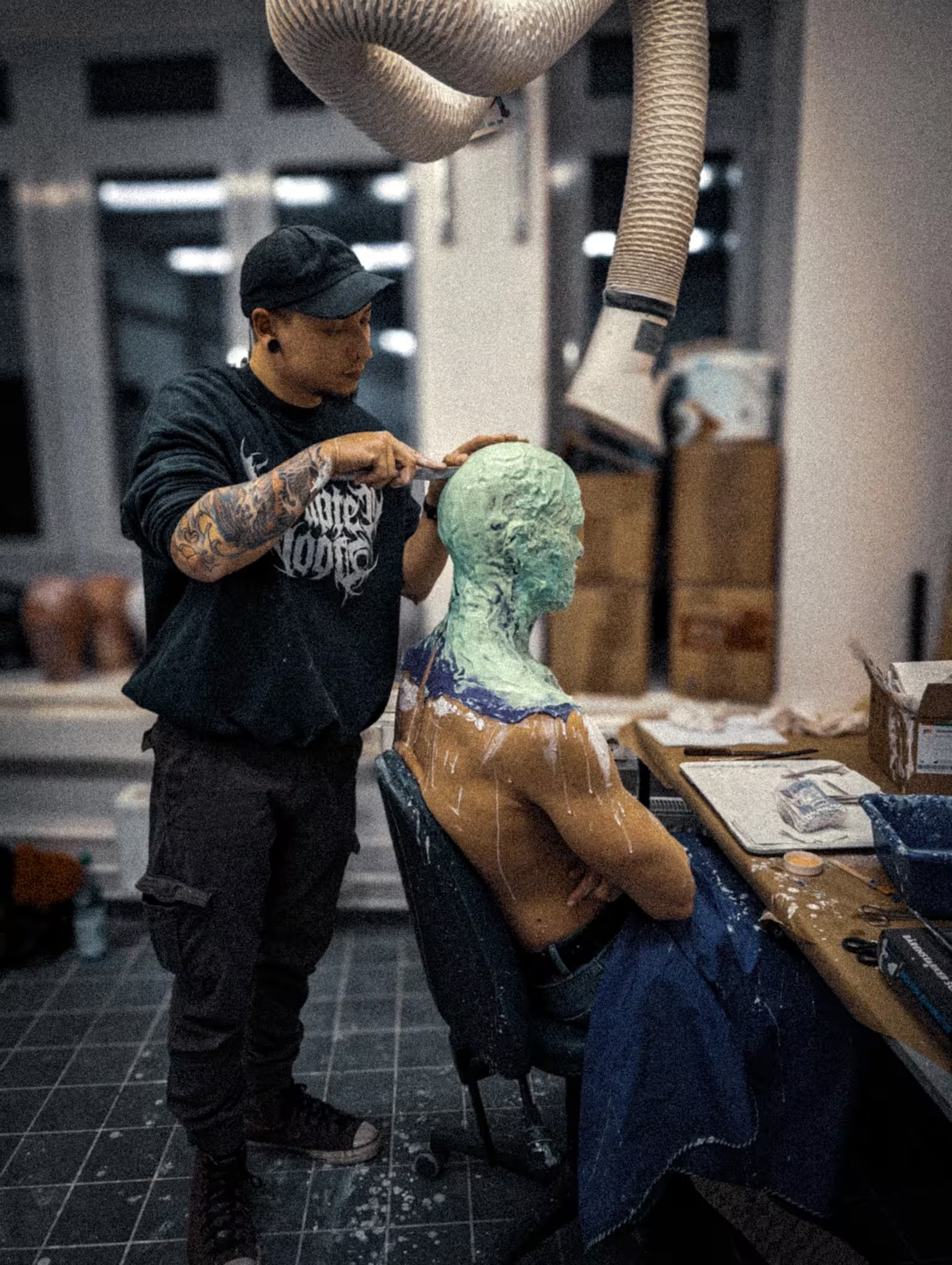
Lifecasting is the process of taking a precise impression of a body area on a living person. This impression serves as the basis for producing a working model on which individual film prosthetics, masks or special effects can be developed.
Unlike a simple set of measurements or a photograph, a lifecast captures the anatomy in three dimensions. Contours, proportions and fine surface textures are reproduced faithfully and form the basis for every subsequent step.
Particularly with bespoke character development, a lifecast delivers a precision of fit that is hard to achieve with universal standard forms.
📷 Recommended image
➡️ Until a dedicated lifecast project has been documented:
old-age-silicone-prosthetic-applying-close.jpg
Fig. 2: The precise fit of a film prosthetic is built on the most exact base possible.
Why is a lifecast so important?
The quality of a film prosthetic does not depend solely on the sculpting or the material used. The base itself already determines how precisely the finished prosthetic sits and how naturally it blends into the performer’s anatomy.
An accurate lifecast helps to
reproduce facial proportions correctly,
account for individual anatomy,
shape transitions precisely,
reduce later adjustments,
make the entire workflow more efficient.
Especially in high-resolution film productions, where the smallest details become visible, a precise working base contributes significantly to the final result.
💡 Practical tip from DoManh SFX
In my experience, it isn’t only the sculpting that determines the quality of a film prosthetic. A clean base makes every following step easier – from character development to the final application.
Which body areas can be moulded?
Depending on the project, different areas of the body can serve as the base for later special effects.
These include, for example:
Face
Head
Neck
Hands
Ears
Torso
Arms
Legs
Feet
Which areas are actually moulded always depends on the requirements of the particular project.
While a nose prosthetic often only involves a small area of the face, a large-scale body prosthetic may require an impression of the entire torso.
📦 Project example – Knabe Mix
For the ageing prosthetic on the Knabe Mix project, the performer’s torso formed the basis of the later character development. Only an exactly fitting base form made it possible to sculpt and realise excess skin and anatomical changes naturally.
➡️ View project: Knabe Mix
When is a lifecast used?
Lifecasts are used whenever individual fit and anatomical precision play an important role.
Typical fields of application are:
Film productions
Series
Commercials
Theatre
Creature design
Ageing prosthetics
Special masks
Body prosthetics
Medical models
Museums
Not every project necessarily requires a classic lifecast, however. Depending on the requirements, digital 3D scans or existing reference models can also serve as a starting point.
Which method is chosen depends on project scope, schedule and the required accuracy.
Classic lifecast or digital 3D scan?
The development of digital technologies has changed the workflow of many make-up artists and prosthetic designers. Where classic lifecasts served as the base exclusively for many decades, high-resolution 3D scanners are increasingly used today.
Both methods pursue the same goal: to capture a performer’s anatomy as precisely as possible. The path to it, however, differs considerably.
Which method is used does not depend on which one is "better", but on the requirements of the particular project.
The classic lifecast
The classic lifecast has been an integral part of professional make-up artistry for decades. It produces a physical impression of a body area, from which a stable positive model is then made.
This model later serves as the working base for sculpting, mould making and the production of individual film prosthetics.
Especially for elaborate character development, a classic lifecast offers a reliable base on which every subsequent step can be built.
Many renowned studios still work with classic lifecasts today or combine them with digital methods.
📷 Recommended image
No lifecast image available yet.
➡️ To be replaced later with our own behind-the-scenes material.
Digital 3D scans
Modern 3D scanners can capture faces and body areas digitally and without contact. The resulting data can then be processed directly in programs such as ZBrush or prepared for 3D printing.
Digital scans offer a high degree of flexibility, particularly on time-critical productions or with complex workflows.
Beyond that, digital models can be archived, reworked when needed, or reused for later projects.
Digitisation does not, however, automatically replace the craft side of character development. Even a perfect scan has to be interpreted and developed further artistically.
📦 Practical example from the DoManh SFX workflow
For certain projects I now work with digital 3D scans as the starting point for character development. This lets me process models efficiently in ZBrush and visualise different design variants early in the project. The actual creative process, though, only begins after the scan.
Lifecast or 3D scan – is there a winner?
This question comes up often but cannot be answered in blanket terms.
Both classic lifecasts and digital scans have their own strengths and are frequently combined today.
Classic LifecastDigital 3D ScanPhysical working modelDigital 3D modelProven workflowFast digital post-processingIdeal for classic sculptingIdeal for digital workflowsDirect basis for traditional working methodsDirect basis for CAD, ZBrush and 3D printing
The decision therefore always depends on the particular project, the available resources and the planned workflow.
💡 Practical tip from DoManh SFX
A digital scan does not automatically replace a good sculpt. It merely provides a precise starting point. Anatomical understanding, artistic skill and experience remain decisive – whether the work is done analog or digitally.
From scan to positive model
Regardless of how the anatomy was captured, a working base for the further character development is created afterwards.
With classic methods this happens via a physical positive model.
Digital data, on the other hand, can first be worked on virtually and then transferred back into a physical model, for example via 3D printing.
Classic and digital working methods therefore do not rule each other out. On the contrary: many modern studios combine both approaches to make the best use of their respective advantages.
📷 Recommended image
➡️ As soon as available:
A screenshot of a ZBrush model or a 3D scan from your workflow.
Until then:
vampire-prosthetics-sculpt.jpg
Fig. 3: Digital tools now complement many classic workflows in prosthetic design.
Why precision already matters here
Many later problems do not first arise during mould making or application, but already from inaccuracies in the starting base.
The more precisely anatomy, proportions and surfaces are captured, the easier subsequent steps are to plan and carry out.
A high-quality base helps, among other things, to:
improve precision of fit
reduce reworking
make sculpting easier
make transitions look more natural
make production processes more efficient
For this reason, capturing the anatomy holds such a high priority in professional prosthetic design.
📦 Project example – Knabe Mix
When developing the body prosthetic for Knabe Mix, the most precise base possible was decisive. The excess skin and ageing features sculpted later were meant to adapt naturally to the performer’s anatomy. An exact starting base made the entire further character development easier.
➡️ View project: Knabe Mix
From lifecast to finished film prosthetic
A lifecast is never the actual end product. Rather, it forms the basis for every step that follows. Only through character development, sculpting and mould making does it become an individual film prosthetic.
You can therefore think of the lifecast like the foundation of a house: the more precise the base, the more stable and accurate everything built on it can be.
The positive model – the first working base
After the anatomy has been captured, a positive model is created. It reproduces the exact form of the later working area and serves as the basis for all subsequent sculpting steps.
Later, you don’t simply "sculpt on top of" this model. Instead, it acts as an anatomical reference against which every change can be checked.
This allows proportions, transitions and symmetries to be reviewed and adjusted precisely at any time.
Whether a small nose prosthetic or a large-scale body prosthetic is created later – almost every individual character development builds on this working base.
📷 Recommended image
➡️ As soon as available:
Positive model of a lifecast
Until then:
knabe-mix-body-prosthetic-mould.jpg
Fig. 4: The positive model forms the basis for every further sculpting step.
Character development doesn’t begin with the sculpting
A common misconception is to assume that the creative work only begins with the sculpting.
In fact, many artistic decisions feed into the project considerably earlier.
Before the first forms are sculpted, questions such as the following are settled:
What story does the character tell?
Which ageing features should be visible?
Should the change look realistic or stylised?
How far may the anatomy change?
Which areas deliberately stay unchanged?
Only once these questions are answered does the actual sculpting begin.
This prevents individual elements from looking impressive on their own but not fitting the overall character later.
📦 Project example – Old Age
With an ageing transformation it is not enough merely to sculpt wrinkles. Ageing processes change the entire facial expression. Skin loses its elasticity, soft tissue shifts and facial contours change. These aspects are already considered during character development and then realised in the sculpt.
➡️ View project: Old Age Prosthetics Make-up
Sculpting – changing anatomy deliberately
On the basis of the positive model, the sculpting then begins.
This is where all the anatomical changes of the later character are created.
These include, for example:
Forehead structures
Cheek areas
Nose shapes
Lip areas
Chin areas
Excess skin
Wrinkles
Creature features
Individual skin textures
The goal is not to sculpt as many details as possible. What matters far more is that every change looks anatomically plausible and supports the intended character.
Especially with high-resolution cameras, unnatural proportions or exaggerated forms stand out particularly quickly.
📷 Recommended image
vampire-prosthetics-sculpt.jpg
Fig. 5: During sculpting the later character takes on its final form.
💡 Practical tip from DoManh SFX
When sculpting, I try not to add as many details as possible, but only those that genuinely support the character. A believable character transformation often comes from many small, coordinated changes rather than from single spectacular elements.
From sculpt to mould making
Once the sculpting is finished, the next important step follows: mould making.
Here the finished sculpt is transferred into a mould from which the actual prosthetic can later be produced.
The quality of the lifecast shows itself particularly clearly at this point.
A precise starting base not only makes sculpting easier, it also ensures that form, precision of fit and surface detail can be reliably reproduced.
For this reason, many prosthetic designers regard the lifecast as an investment in the quality of the entire project.
📷 Recommended image
knabe-mix-body-prosthetic-mould.jpg
Fig. 6: Once the sculpting is complete, the mould for producing the film prosthetic is created.
Why precision affects the entire workflow
Every step builds on the previous one.
Even small inaccuracies can carry through the entire production process and lead to additional adjustments later.
A precise working base therefore supports:
a more natural fit
more harmonious transitions
more efficient sculpting
more precise mould making
more even material thicknesses
easier application on set
Lifecasting is therefore far more than just a preparatory step. It influences the entire further workflow and contributes significantly to the quality of the finished character transformation.
📦 Project example – Knabe Mix
When developing the body prosthetic for Knabe Mix, excess skin, chest area and torso had to be matched exactly. Even small deviations in the base form would have carried through the entire production process.
The precise base made not only the sculpting easier, but also the later mould making and the final fitting of the prosthetic.
➡️ View project: Knabe Mix
Lifecasting in modern film productions
Whether feature film, advertising campaign, theatre production or high-end cosplay – wherever individual characters are created, a precise lifecast is often the starting point of the entire production process.
With increasing digitisation the tools have changed, but the goal has stayed the same: to capture a performer’s anatomy as exactly as possible in order to build a believable character on it.
Many modern studios today combine classic lifecasts with digital 3D scans and then continue sculpting in programs such as ZBrush. Other productions deliberately work fully analog. Which method is used always depends on the project’s requirements, the schedule and the desired workflow.
Regardless of the chosen technique, the basic idea remains unchanged: the more precise the starting base, the more efficiently and to a higher standard every further step can be carried out.
📦 Project example – Custom Old Age Body Prosthetic „Knabe Mix“
For the advertising campaign „Knabe Mix“, an individual body prosthetic was created that aged the character’s torso considerably. A precise starting base was decisive so that the sculpted excess skin and anatomical changes adapted naturally to the body.
The prosthetic’s later fit was not down to chance, but to careful preparation right at the start of the project.
➡️ Related project: Custom Old Age Body film prosthetic for „HandOfBlood“ – Knabe Mix
Why lifecasting is a mark of quality
To outsiders, a lifecast often looks like a preparatory intermediate step. In practice, however, it is one of the most important foundations of professional character development.
A precise working base helps to
capture the anatomy correctly,
develop individual fits,
make later sculpting steps easier,
use material efficiently,
reduce reworking, and
raise the quality of the finished prosthetic.
Especially on productions with high-resolution cameras or elaborate close-ups, this difference can be decisive.
💡 Practical tip from DoManh SFX
A good lifecast should be as "invisible" as possible later on. When a film prosthetic sits perfectly, hardly anyone talks about the lifecast – yet that very step was often the cornerstone of the entire result.
Frequently asked questions (FAQ)
What is a lifecast?
A lifecast is a precise impression of a body area on a living person. It serves as the basis for developing individual film prosthetics, masks and other special effects.
What is a lifecast needed for?
A lifecast makes it possible to fit prosthetics precisely to a performer’s anatomy. This achieves more natural transitions, a better fit and an altogether more convincing result.
Does every film prosthetic require a lifecast?
No. Smaller standard prosthetics or universal products can also be made without an individual lifecast. For bespoke character development, however, a lifecast or a digital 3D scan often forms the basis.
Can a 3D scan replace a lifecast?
Digital 3D scans now offer many possibilities and are established on numerous productions. Whether a classic lifecast, a scan or a combination of both makes sense depends on the particular project and workflow.
Which body areas can be moulded?
Depending on the project, the face, head, neck, hands, arms, legs or torso, among others, can be captured. Which areas are needed depends on the planned character development.
Is lifecasting part of make-up artistry?
Yes. Lifecasting is an important part of professional special-effects make-up artistry and often forms the starting point for sculpting, mould making and the later production of individual film prosthetics.
Conclusion
On many professional character developments, lifecasting is the first decisive step. It creates a precise base on which every further step is built – from character development through sculpting to mould making and the finished film prosthetic.
Whether a classic lifecast or a modern 3D scan: what matters is not the method itself, but the quality of the captured anatomy and its sensible integration into the overall workflow.
A convincing film prosthetic therefore begins long before the first sculpting step – it begins with a precise base.
Related content
Related services
Film Prosthetics & Character Transformations
Character Development & Sculpting
Mould Making & Special-Effects Fabrication
On-Set SFX & Production Support
Related projects
Custom Old Age Body film prosthetic „Knabe Mix“
Multi-part Old Age Prosthetics – Schauspiel Hannover
Alien SFX Make-up – ZDF Streamergarten
Anatomical sculpting for midwifery exam props
More articles in the Knowledge Base
KB-001 – What are silicone prosthetics?
KB-002 – How are professional film prosthetics made?
KB-004 – Character Development & Sculpting (coming soon)
KB-005 – Mould Making for Film Prosthetics (coming soon)
KB-006 – Encapsulated Silicone Prosthetics (coming soon)
Image plan
Hero image
Provisional:old-age-silicone-prosthetic-applying-close.jpg
(Once our own lifecasting process is documented, we’ll replace this image.)
Figure 1
Image:old-age-silicone-prosthetic-applying-close.jpg
Figure 2
Image:knabe-mix-body-prosthetic-mould.jpg
Figure 3
Image:vampire-prosthetics-sculpt.jpg
Figure 4
Image:knabe-mix-body-prosthetic-finished-sfxmakeup.jpg
Sources and further reading
This article is based on practical experience from film, advertising and theatre productions as well as on widely recognised working methods in professional special-effects make-up artistry.
For further reading, the following are worth exploring:
Smooth-On – mould making and casting systems
KauPo – materials for prosthetic makeup
FormX – mould making and modelling materials
Stan Winston School – Prosthetic Design & Character Creation
Gorton Studio – character design and make-up artistry